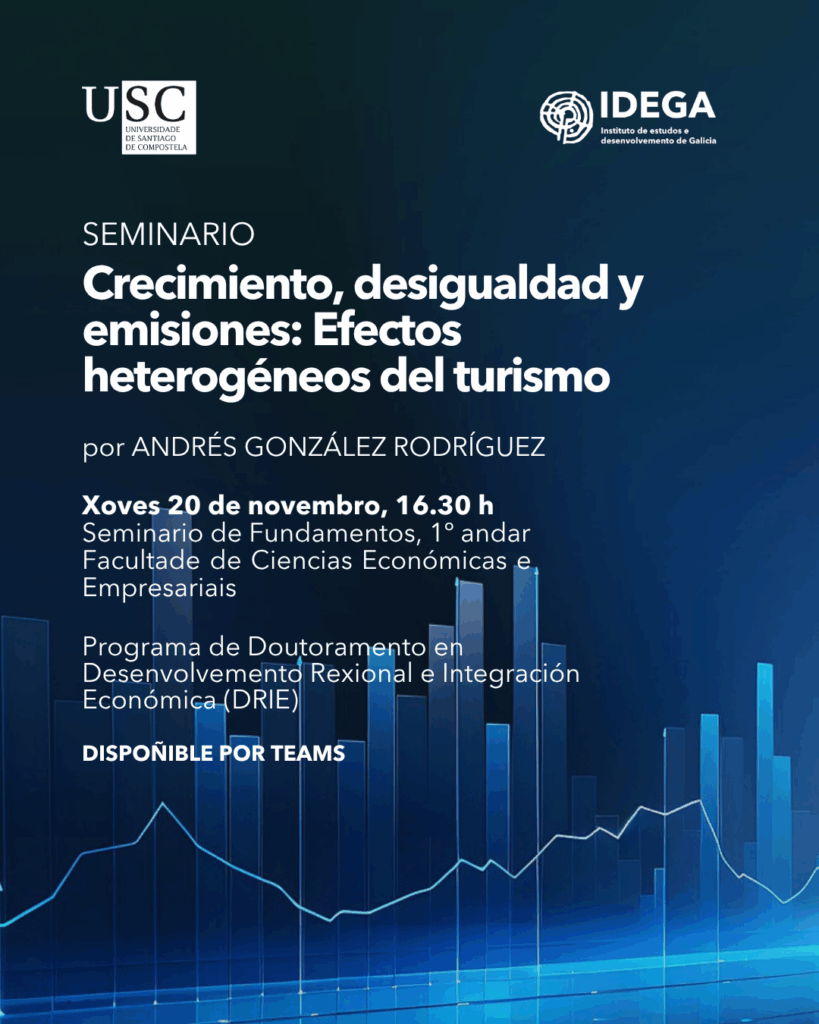

This coming Thursday, October 20, the Doctoral Program in Regional Development and Economic Integration (DRIE), the program of the seminar of Growth, inequality and emissions: heterogeneous effects of tourism, the hand of the researcher Andrés González Rodríguez.
The intensification of tourism in our societies makes it necessary for the pursuit of sustainability of the same on your strands economic, social and environmental. The present study, which is exposed in the Faculty of Economic and Business Sciences of the University of Santiago, analyzes, for every euro of expenditure tour of three indicators: the gross value added (GVA) generated, an indicator of distributive justice based on the index of Atkinson and the emissions attributed to CO2 emissions.
With a social accounting matrix (SAM) Spain (2019) and the OECD data, we estimate the differential impact of 77 types of tourism sorted by country of origin of the visitor. In this way, we observed an impact markedly heterogeneous in each of the variables according to the type of tourism. Through the simulation of the scenarios defined by the priorities of the agenda, was determined with the precision of the goods and the spending patterns are crucial to achieve the objectives set.
The results show that tourism is not a homogeneous phenomenon and support the adoption of policies differentiated that promote these modalities are able to generate more VAB, reduce inequality, and to minimize the carbon footprint. These guidelines provide operational criteria for the progress of tourism development a competitive, equitable and low-carbon.
If you can’t see the shape of the face-to-face and wish to participate in the Equipment, you can request the access data to the meeting to the e-mail address idega@usc.gal.